NEOJIBA: Confronting Community Trauma
Author: Bella Lordelo Ramos (Brazil)
Editor: Deborah Wanderley dos Santos
The Academy of Impact Through Music, in partnership with The Global Leaders Institute, are strengthening the global music education community by providing a platform for AIM Firebird alumni to share their impactful global case studies, aiming to foster knowledge exchange and inspire further innovation in music education worldwide.

BACKGROUND
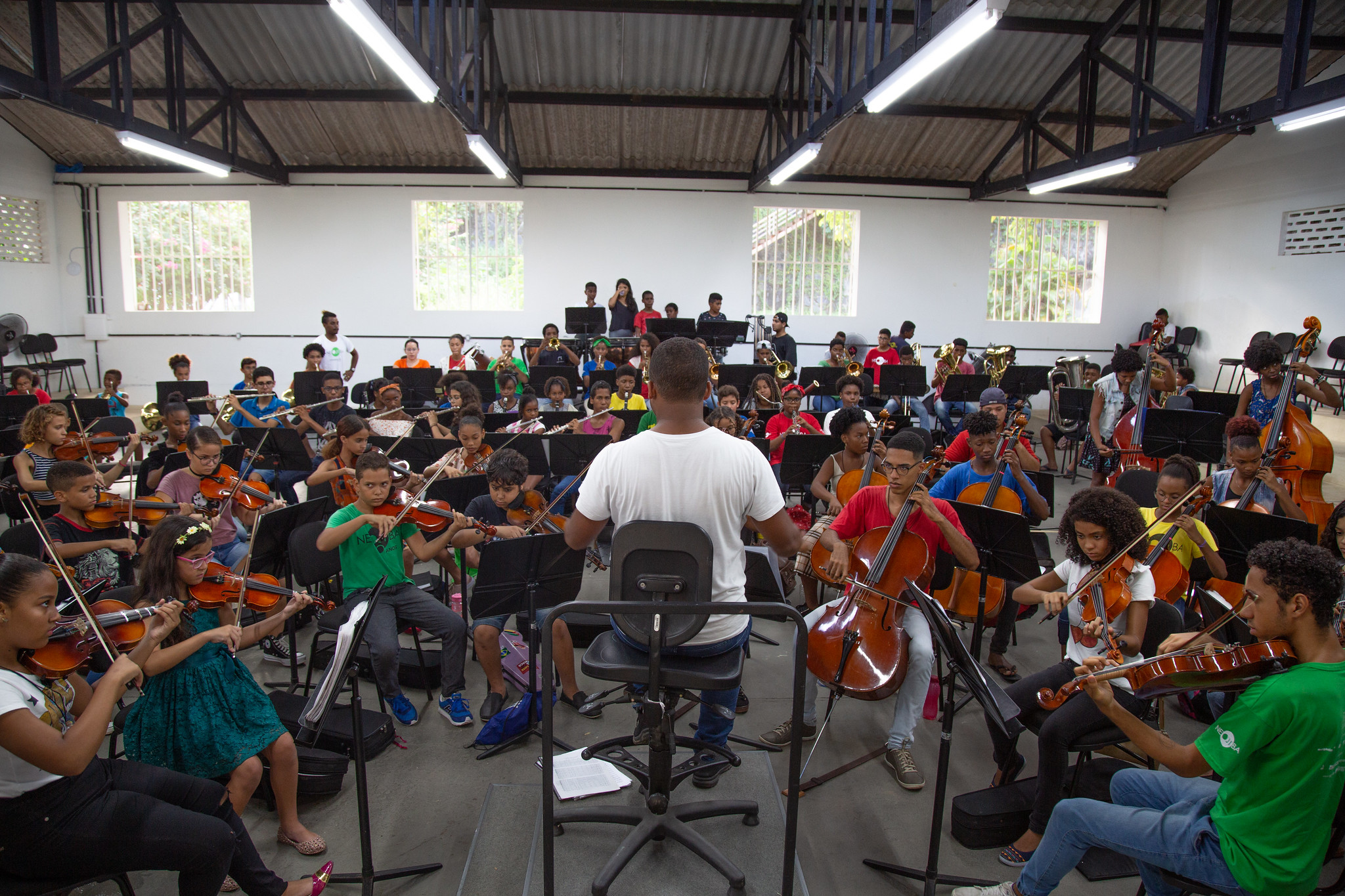
NEOJIBA (Nucleus of Youth and Children’s Orchestras and Choirs of Bahia) is a cornerstone of social policy in Bahia, Brazil. Managed by the Institute for Social Development through Music under the auspices of the state’s Secretary of Justice and Human Rights, the program provides universally accessible music education as a catalyst for human development. Inspired by Venezuela’s El Sistema, NEOJIBA operates 13 centers that have directly served approximately 30,000 children and youth. The organization’s activities have also indirectly benefited over 24,000 individuals through partner initiatives, establishing it as a large-scale, high-impact social program.

BUSINESS AND ORGANIZATIONAL MODEL
NEOJIBA’s organizational model is predicated on a theory of change in which intensive, high-quality musical training serves as the primary intervention to foster social development and community integration. The program’s inputs consist of state funding, philanthropic support, and skilled educators. Its core activities are ensemble-based music classes, rehearsals, and performances. The intended outputs are technically proficient young musicians and artistically excellent ensembles. The ultimate desired impact is to improve life outcomes for youth in underserved communities by cultivating discipline, teamwork, and self-esteem, thereby creating a positive alternative to the cycles of poverty and violence.
STRATEGIC CHALLENGE
A significant external factor is threatening the efficacy of NEOJIBA’s core model. Many of the program’s centers, including the CESA Center in Simões Filho, operate in territories characterized by extreme violence. Simões Filho ranks as the third most violent city in Brazil, and the state of Bahia has more cities on the nation’s most violent list than any other. The chronic stress, anxiety, and trauma experienced by students living in these environments act as a direct impediment to the learning process. These psycho-social barriers impair concentration, inhibit self-expression, and undermine the safe, collaborative environment required for effective musical instruction. This reality presents a strategic question for the organization: Is the existing music-centric curriculum sufficient to achieve NEOJIBA’s social mission in high-trauma environments, or must the model evolve to directly address the well-being of its beneficiaries as a prerequisite for artistic and personal growth?
VALUE-ADDED CONCEPT
To address this challenge, a pilot initiative was developed and implemented with a beginner’s class of 20 students aged 7 to 15. The program introduced an integrated framework focused on fostering emotional and physical well-being as a direct enabler of musical education and community building. This concept reframes well-being not as an extracurricular activity but as a core component of pedagogy. The intervention was designed around a set of teachable skills, including mindfulness through meditation, physical regulation via stretching and breathing techniques, and socio-emotional learning through exercises in non-violent communication and conflict resolution. The central innovation was the use of body awareness, specifically focusing on posture, as a tangible anchor to connect these practices to the physical demands of playing an instrument. This approach makes abstract concepts of well-being concrete and immediately applicable within the context of a music class.
IMPLEMENTATION CONSIDERATIONS
The pilot was executed by integrating specific well-being activities into the daily class routine. Each session began with informal group discussions to create a space for safe sharing, followed by structured activities focused on socialization and emotional regulation. To ensure cultural relevance and foster a strong sense of identity, the curriculum incorporated Afro-Brazilian musical traditions, most notably capoeira. The foundational capoeira movement, the ginga, was used as a warm-up exercise, creating a direct physical and cultural link between bodily awareness and the posture required for playing string instruments. Progress was monitored through qualitative self-assessment charts where students tracked the relationship between their personal motivation and group harmony, as well as the connection between daily practice and postural improvement. The pedagogical approach emphasized student agency, with activities being collaboratively developed, executed, and evaluated by the class to foster collective ownership.

IMPACT ANALYSIS
The integration of the well-being framework yielded significant and measurable outcomes. The most powerful evidence of impact was a marked increase in student agency and leadership. In one notable instance, a previously introverted student independently initiated and led a class warm-up activity using non-verbal cues, demonstrating a profound shift in confidence and peer influence. This behavioral change, observed across the cohort, directly correlated with heightened classroom engagement and a stronger sense of community. Furthermore, the program demonstrated an ability to accelerate artistic development. By effectively mitigating the psycho-social barriers to learning, the students progressed from general musicianship activities to delivering their first public concert within four months, a key performance indicator of the framework’s effectiveness. The initiative proved that addressing students’ well-being is not a diversion from musical training but a direct investment that enhances the efficiency and impact of the core curriculum.

DECISION POINT
The pilot program successfully demonstrates that an integrated well-being framework can address critical barriers to learning in high-trauma environments, thereby strengthening the impact of NEOJIBA’s social mission. The evidence indicates that this approach fosters student agency, builds resilient communities, and accelerates artistic achievement.
The leadership of NEOJIBA must now decide how to proceed with this validated concept. Three strategic options present themselves. The first is to standardize and scale the framework, developing it into a formal curriculum to be implemented across all 13 NEOJIBA centers. This would ensure pedagogical consistency and maximize system-wide impact but would require significant investment in teacher training and curriculum design. A second option is to deploy the framework as a targeted intervention, resourcing its implementation only in the centers located in the most violent territories. This approach would focus resources where the need is greatest but could create programmatic inequities across the organization. A third, more decentralized option is to package the methodology as a voluntary toolkit, making the practices and resources available to all educators but not mandating their use. This would be the lowest-cost option but would likely result in inconsistent implementation and a diffuse, difficult-to-measure impact.

The decision on which path to pursue will determine how NEOJIBA strategically balances standardization with customization, allocating finite resources to best support the holistic development of the thousands of children it serves.